
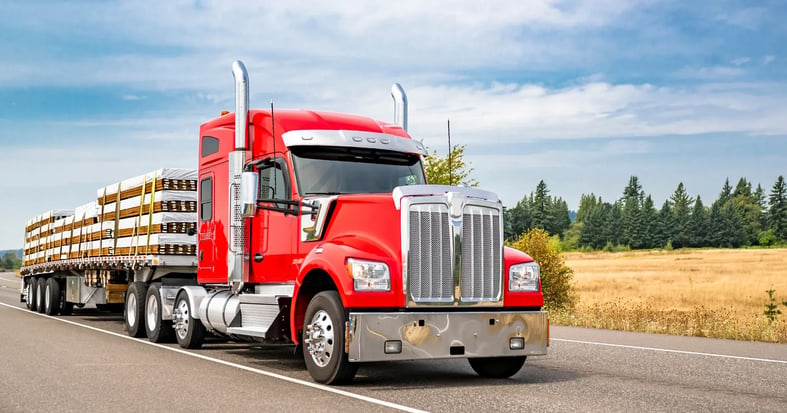
Flatbed operations earn their premium through hard work. You’re not just hauling freight—you’re handling and securing it, often on top of the load in any weather. This can lead to more physical cargo interaction, increased risk of load shifts and falling objects, and higher roadside inspection risk due to securement.
The good news is that flatbed losses can be predictable. When you name the biggest exposure categories, you can train around them, tighten documentation, and build insurance coverage that matches the real-world hazards of open-deck hauling.
tHE SEVERITY mULTIPLIER
For flatbed carriers, securement is not just compliance—it’s the hinge point between a normal trip and a catastrophic event. A shifted load can trigger a rollover, damage infrastructure, or spill cargo into traffic. FMCSA’s cargo securement rules are designed to prevent freight from shifting on or within a CMV or falling from it. The underlying standards in 49 CFR Part 393, Subpart I, specify performance criteria, tie-down requirements, and commodity-specific rules.
This exposure can be costly because it escalates quickly. One failed strap can cause a crash, a cargo claim, and an out-of-service event. Best practice treats securement as a process that includes pre-load checks, working load limit math, edge protection, and regular re-checks after starting, rough roads, or changes in conditions.
TARPING, CLIMBING, AND STRUCK-BY HAZARDS
Flatbed drivers can be hurt more often because they climb, throw straps, chain heavy freight, and handle tarps. Falls from trailers and loads can cause serious injuries, even when parked. OSHA’s fall protection rules require employers to protect workers at certain heights, and hazards exist wherever employees work at heights. The baseline duty to provide fall protection (29 CFR 1926.501) often applies to many work-at-height situations.
Struck-by injuries are also common: binders snapping, chains recoiling, winch bars slipping, and shifting cargo during loading/unloading. These claims can drive workers comp. costs and long-term premium stability. The most effective prevention strategies are the simplest: consistent PPE, three points of contact, safe tarping methods, and coaching that focuses on habits rather than just rules.
LOADING/UNLOADING, DAMAGE, AND DISPUTES
Many flatbed losses occur at customer sites. Forklifts can damage product, cranes can hit trailers, and ground crews may miscommunicate during lifts. These events lead to costly damage claims and disputes over who is responsible. Clean documentation helps, specifically photos before departure, signed bills with condition notes, and clear instructions.
Finally, flatbed freight such as steel, lumber, equipment, and building materials is often high value and difficult to replace. This should influence both your operational procedures (secure parking, tarping quality, route planning) and the insurance program you choose.
the name you can trust
At Joe Morten & Son, Inc., we work with trucking operations to protect their bottom line. If you’re in the market for an agency that puts you first, we’re here to help.
Note: These lists are not intended to be all-inclusive.

We offer commercial trucking coverage in more than 45 states. Check out more information in your state:
Alabama, Arizona, Arkansas, Colorado, Connecticut, Delaware, Florida, Georgia, Idaho, Illinois, Indiana, Iowa, Kansas, Kentucky, Louisiana, Maine, Maryland, Michigan, Minnesota, Mississippi, Missouri, Montana, Nebraska, Nevada, New Hampshire, New Jersey, New Mexico, North Carolina, North Dakota, Ohio, Oklahoma, Oregon, Pennsylvania, Rhode Island, South Carolina, South Dakota, Tennessee, Texas, Utah, Vermont,
Virginia, Washington, West Virginia, Wisconsin, and Wyoming.
This material is intended to be a broad overview of the subject matter and is provided for informational purposes only. Joe Morten & Son, Inc. does not provide legal advice to its insureds or other parties, nor does it advise insureds or other parties on employment-related issues, therefore the subject matter is not intended to serve as legal or employment advice for any issue(s) that may arise in the operations of its insureds or other parties. Legal advice should always be sought from legal counsel. Joe Morten & Son, Inc. shall have neither liability nor responsibility to any person or entity with respect to any loss, action, or inaction alleged to be caused directly or indirectly as a result of the information contained herein. Reprinted with permission from Great West Casualty Company.